


The way to stand out in business goes through your brand voice.
Spread the loveYour brand voice is the North Star of your content. It’s what will allow you to be consistent in the messages you convey to your audience, to create a public persona that they can connect with, and ultimately, to engage the audience and build trust. And trust is the first factor that distinguishes […]

Your brand voice is the North Star of your content. It’s what will allow you to be consistent in the messages you convey to your audience, to create a public persona that they can connect with, and ultimately, to engage the audience and build trust. And trust is the first factor that distinguishes between sales and struggles.
A few days ago, I was talking to a good friend of mine. We talked about digital nomadism and her experiences in Thailand, and she said to me, “What can I tell you, it sounds like you have a tough life.” It’s clear to anyone who reads this that she meant it sarcastically. Even though her words said “you have a tough life,” what she actually meant to say was “your life is amazing.”

So how did we know what she meant?
We had context and were able to interpret her words, even though they said the opposite of their true intention.
When we speak in a loud voice, it’s much easier for us to express our true feelings and intentions behind the words, regardless of their literal interpretation.
When we talk about a brand, especially one that communicates with its audience digitally, we need to think about the “personality” of the brand because it actually affects how customers feel about the brand and how they interpret its personality.
For example, a brand that chooses to address its audience in the second person (you, yours) and uses simple language and “regular” words will be perceived as more accessible than a brand that addresses an amorphous audience or uses third-person language, complex wording, and high jargon, which will be perceived as more formal and distant.
It’s important to remember that there is no right or wrong. It all depends on the audience, who we’re talking to, and what the brand wants to convey.
In one of my projects, I created a brand foundation for an international conference company for medical corporations. Even though we decided to use the second person, we still phrased it slightly higher and less accessible to show “respect” to the doctors who are accustomed to being treated with a certain level of formality.
When you take the time to build your brand’s tone of voice, remember that the personality and values of the brand include the words, expressions, and structure you choose. Your brand voice needs to be consistent across all your media and marketing materials, including website content, social media posts, emails, presentations, and even correspondence with customers.
However, it’s important to understand that just as the character of a specific person changes according to the situation and the people they encounter, so too can a brand adapt itself to different audiences or platforms while still maintaining its core values and main character traits.
Some tend to separate Brand Voice and Tone of Voice because there’s a clear difference between them. But I always use them together because, in my opinion, they can’t truly be separated.
Brand Voice should be the comprehensive personality of your brand, the character if you will. And the tone of voice is the choice of words, expression of feelings, and connection created with the audience. In general, if we compare it to a person, the character doesn’t change, but the form of expression tends to vary slightly depending on the audience and situation. But they always come together.
Why should you invest in creating your brand’s tone of voice?

In one word – Engagement.
In more detail – building trust and emotional connection with your audience.
I talk a lot about the importance of connecting with our audience and fostering open dialogue with them.
Just a month ago, a large international organization (present in 90 countries) approached me because their digital assets (websites, landing pages, emails) were written inconsistently. Their website exhibited several styles, varied approaches, and even conflicting messages.
This inconsistency confuses the audience and hinders their ability to fully engage with the brand.
Even if customers can’t quite articulate what bothers them, the lack of emotional connection becomes apparent. After all, how can one trust someone who communicates differently at every turn and describes their actions in different languages?
For another client, we developed a branding foundation and began crafting marketing assets aligned with the brand’s tone of voice. We integrated the brand’s distinct voice into their website (if it’s not entirely clear, don’t worry, I’ll explain how to do it later). Within a month of launching their new website, they received more inquiries than in the entire previous seven months. And naturally, this was reflected in their sales figures as well.
This outcome isn’t surprising, especially after reading on the LucidPress website that consistent branding increases sales by an average of 23%.
It’s important to note – your brand perception isn’t solely determined by written language and preferred tone. Visual language, user experience, customer experience, and clear marketing and sales channels are crucial elements in conversion and brand-building. Brand voice serves as the foundation of your brand, but it’s just one piece of the puzzle.
Who will help your brand find its unique voice?
The tone of voice can be defined by an employee in the organization, a brand strategist, a content marketing strategist and consultant (hello! that’s me), a creative manager, or even a branding agency.
Regardless of whom you choose, it’s important that the same entity has multiple skills and versatility, such as a high level of expression, analytical skills and the ability to draw conclusions for audience research, a deep understanding of the culture and values of your brand, and an open and creative mind.
How to find your brand’s tone of voice?
We’ll start by creating precise personas and defining our target audience in order to know who we’re talking to. What language to use and which mode of communication will be most appropriate.
The next step is to identify our brand values. If you’re a new brand, you can simply understand what your top five values are (if you’re a brand of one person, it’s even easier). If you’re a brand that’s been around for a few years and has written content, I really invite you to go back and see which posts, emails, or sales pages were the most popular and successful among your target audience. Once you have a list, try to extract values and expressions from them. The right answer, it’s reasonable to assume, is in the content you’ve already created and that the audience has connected with.
The more you can build clear guidelines for your tone of voice, the better you can execute marketing processes. This means you can rely on writing professionals with full confidence when they create marketing assets for your brand. The more the marketing team knows the guidelines and how to use the brand’s preferred tone, the more the content they write will convey the same messages and reflect the brand’s character.
Step 1: Build precise personas for your target audience
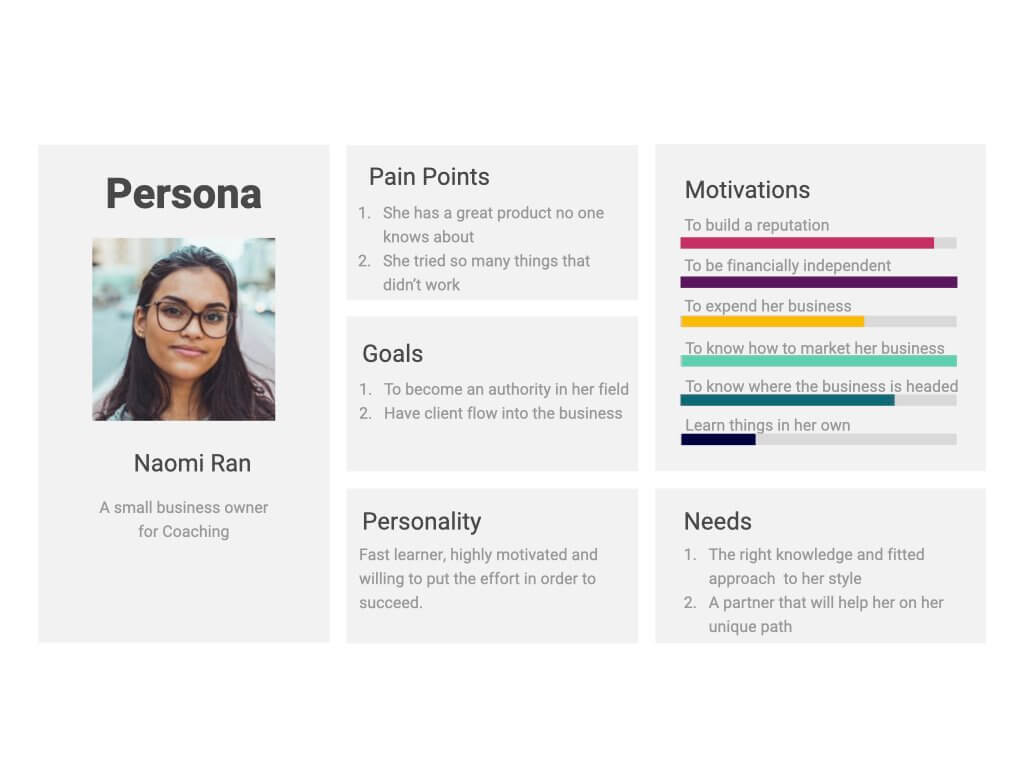
If you Google “building personas,” it’s reasonable to assume they’ll send you to write about the gender, age, areas of interest, education, occupation, and income of your audience. That’s important, but I wouldn’t stop there. I’d try to understand which social networks they’re on, how they express themselves. I’d extract the important values to them through posts they write or questions they ask.
Another thing, it’s common to think that the personas we’re talking to are only those who are going to buy our products. But most of the audience following our brand won’t purchase anything from us. However, they might become followers, reactors, and even advocates who will recommend us to paying customers.
Building a persona will help us understand what role we take in front of the audience. Are our personas looking for inspiration, and are we talking to them as mentors? Does our audience need a sense of “togetherness,” and do we speak to them as equals? Or perhaps our audience needs to be educated, and we speak to them as teachers?
Invest in personas and understand from which angle you need to address them.
Step 2: Brand Core Values

Brand core values should be reflected in the written content of the brand.
Of course, if we choose 5 values, not all of them can be present in every written piece. The values will find themselves present in texts and marketing materials through the words, design, colors, and how they are promoted.
From today, your brand will have its own style, with specific values.
My brand’s values are: transparency, humor, creativity, development, and freedom.
When I write content or create new designs for my brand, it must reflect these values consistently.
Imagine if I told you that transparency is important to me, but there’s nothing authentic in my content that tells about me or exposes my true self. Or if I offer a course but don’t operate transparently with the participants.
When you choose values, they’re there forever. Or at least until you decide, thoughtfully, to change them. They must be present in your conduct, in your content, and in the basis of your brand’s actions.
To define your core values, I like to ask the following questions:
Why was the company, organization, brand, or business founded?
What sets your brand apart from other brands in the field?
What does your brand represent? Whom does it represent?
What conclusions would you like people to draw about your brand?
What values are most important for you to share with the audience?
Many times in personal processes, my clients say things like, “Professionalism” or “Reliability.” In my eyes, these are values that are self-evident. No business will say about itself that it’s not professional or not reliable.
It’s important to choose unique values that will truly distinguish you in front of your audience and will be another factor for identification.
Step 3: Mission Statement

After defining your brand’s values, the next step is to create a concise mission statement for the brand for your audience. This is an opportunity to illustrate to our readers who we are, what we do, and whom we can help.
This is my mission statement >>
My goal is to provide unique insights that will help my audience develop a dialogue around creating quality content that will turn them into authorities and help them in their business, alongside developing the appropriate skills that will help them achieve business success.
What comes to your mind when you read my mission statement? What do you understand about me? About my activity? This is exactly the process your customers will go through with the break you choose to write.
I recommend making a list of the 50 most relevant job titles in your industry. Browse through your competitors and extract descriptions of their activity from there. Go to similar industries and do the same. And then try to divide all job titles into three categories:
- Who we are
- Who we want to be
- Who we are not
- Your mission statement is in category No. 2.
- Your rejection is in No. 3.
Step 4: Brand Tone of Voice
We’ve reached the final stage, where all the information converges into the brand’s tone of voice. This is the point where persona research, brand values, and storytelling meet. The brand’s tone of voice. Let’s begin.
Firstly, it’s important to know that there are 4 key dimensions according to which we divide the tone:
- Formal vs. Informal
- Humorous vs. Serious
- Respectful vs. Irreverent
- Enthusiastic vs. Matter-of-fact
I assume your brand doesn’t exist in a vacuum, and you already have written and prepared content.
To build the brand’s tone of voice, you need to understand two important things:
- How the brand currently sounds. That is, what our audience understands about us from the content we’ve written so far. What are the values reflected from the content, what are the brand’s character traits.
- How the brand would like to sound. That is, the new guiding principles you’d like the brand’s marketing content to have.
Formal vs. Informal
After having hundreds of people attend my writing workshops or marketing coaching sessions, there’s one common denominator among most people. Their writing is much more formal than their character. Not by choice, but because that’s how they were taught. They talk about themselves in third person, add terms like “I would like to disclose that…” or “I’d like to order…”.
Don’t get me wrong, there’s nothing wrong with formality. But the choice of the level of formality must be conscious and with a brand rationale. The way we write has a great impact on how our audience sees our brand.
Using a highly formal language may indeed help us appear authoritative, but it may also feel distant and inaccessible. On the other hand, using everyday language might be perceived as casual or lacking the seriousness of the brand. Between formality and informality, there’s a broad spectrum of two dimensions. Try to understand what’s important to you and how you’d like potential customers to understand your brand.
Humour vs serious

One of the remarkable things that happened in recent years is that the brands we know and love are also accessible and personalized. Humour is a positive emotion that encourages further content consumption. It makes sense, after most aspects of our lives are serious, many audiences want a bit of escapism. They want the brand they follow to feel like a friend. Humorous content stimulates imagination and therefore is more memorable.
However, it’s important to remember that humour doesn’t always fit in every situation, and not everyone shares the same associations and sense of humour. It’s risky, but I can say it works for me. If you choose humour, make sure you’re not in the zone of being unserious or unprofessional.
A serious and mixed tone will help you be perceived as a brand that “knows,” which increases credibility with the audience. However, a consistently serious tone can become monotonous, unmemorable, and lacking personality. It’s like going on a date with someone who is really handsome. We want it to work, but when the conversation doesn’t flow… or, oh my god, I’ll settle for someone less handsome but with whom I have a connection.
Respectful vs. Bold
To respect our audience, give them a place of honor, and be careful with the terms we choose can work in our favor. The Israeli audience, for example, likes to be appreciated and have their egos stroked. Israelis don’t want to feel like fools, and when we explain to them clearly that we put them at the center, they will flock to your brand. However, it’s important to remember that the same Israeli audience is not formal and mixed and loves slang and taking things to extremes. Being too respectful may sound like whoever wrote your brand’s content is a bot. Some kind of AI system that still doesn’t know how to navigate the world.
Even if your audience is enthusiastic researchers, I would try to understand what their values are and whether you can “play” a little with the language.
Boldness and creating a quirky brand voice will indicate that the brand is confident and authoritative. Maybe even “elitist” over alternatives. It doesn’t suit every brand, and if you choose a bold style, my recommendation is to own it alongside creating a visual and linguistic language that supports the brand and its voice.
Enthusiasm vs. Informative
I have a wonderful friend who is one of the most enthusiastic people about soccer. Responsibility. Just hearing her talk about her adventures, her new clothes, or even some future plan – it manages to put me in a mode of listening. But sometimes it just doesn’t fit. An enthusiastic tone gives a feeling of magic, but in overuse, it can tire or annoy the audience. Excessive enthusiasm is exhausting.
On the other hand, an informative language gives a feeling of honesty and simplicity. Like sitting with a good friend over a cup of coffee and talking about everything. But the brand is not the best friend. When it’s executed poorly, it may come off as indifferent or personality-less. And that’s the worst thing that can happen to your brand’s voice.
Not everyone’s enthusiasm is suitable, just as not everyone knows how to sound informative. I would think about how this aspect fits into the rest of your brand’s voice.
Step 5: Brand Voice Tone Refinement
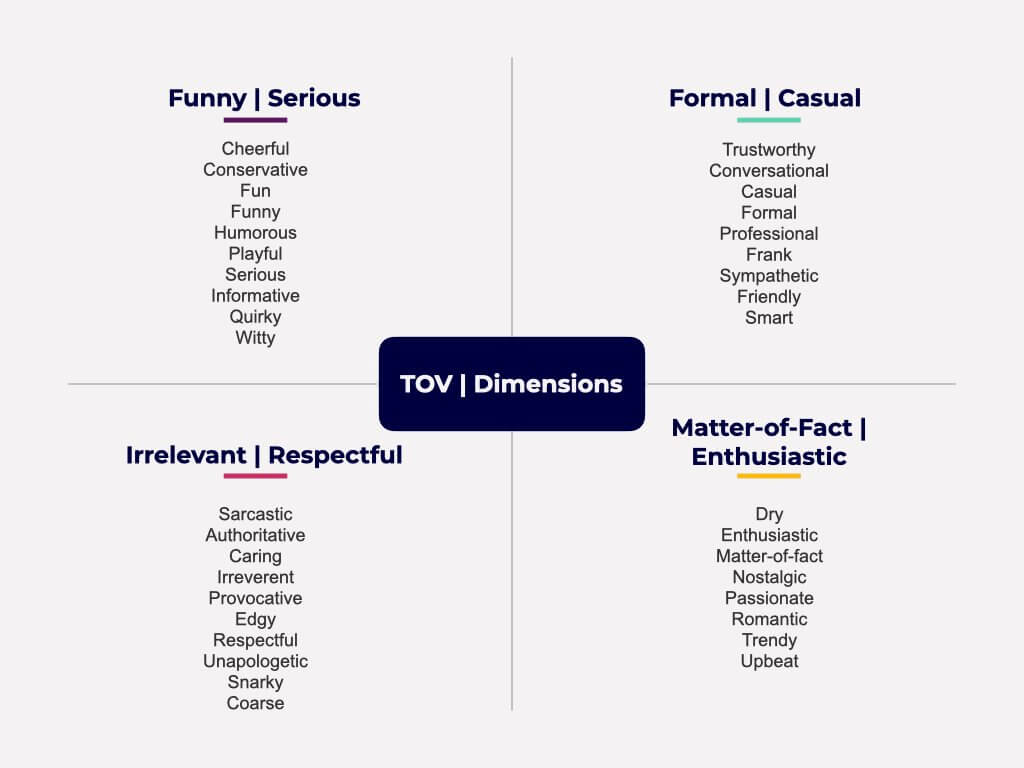
It’s clear to me that in reading, there were things you connected with more and less. Character indicators for the brand that you clearly identified as yes, as opposed to those that are really not. Have you identified where your brand stands within each of the four dimensions? Perfect! Now we need to give them names that describe the character of the brand, like “playful,” “unique,” or “down-to-earth.”
There’s a list of 37 words created by the Norman group that you can use.
To make it more efficient, I tried to categorize these words into the four dimensions. This doesn’t mean it’s the correct categorization. You are completely welcome to rearrange this list differently or add other words that describe your brand.
My favorite table: Brand Voice!
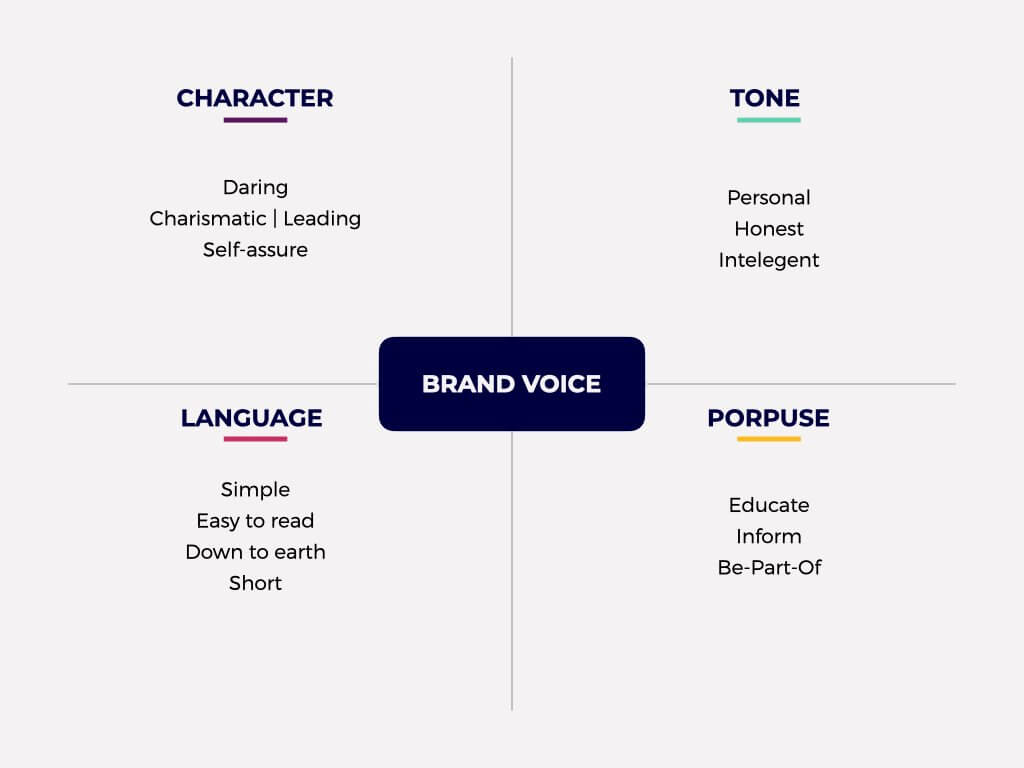
The brand voice table really helps to understand how your brand will be consistent in its messages and the tone it chooses to present.
We divide the table into four parts:
- Character
- Tone
- Language
- Purpose
Here, in plain black on white, you will need to choose the character of your brand. For example, bold, charismatic, and self-assured. And what tone you will use in the content. For example, personal and trustworthy. How the language will be written. For example, simple, easy to read, and short sentences. And what is the purpose of the writing. For example, to educate, inspire, or drive purchases.
The purpose itself varies within different projects within the brand.
For example, on a landing page, the purpose could be “encouragement to take action and leave details,” while the purpose in blog writing could be “to educate and help others develop.”
Step 6: Using Brand Tone
Like any good thing that requires consistency, templates, and guiding lines, it will make your life easier. It’s important to remember that brand voice guidelines are not something you do once. Rather, it’s something you return to when there’s a change in the product, target audience, or company values.
Think about it, a company of 2-3 people will produce different content than a company of 500 people. Therefore, in organizational growth processes, rebranding, and in general, for renewal needs, it’s possible and even desirable to re-examine the language and tone of the brand.
Brand language guidelines
The goal in creating easy-to-follow guidelines is that even if your marketing person changes or you decide to outsource the writing, your language and tone will still be preserved.
The clearer and more inclusive the guidelines are with rules and examples, the easier it will be for you to use them. If you can also provide some examples of what not to do, that would be fantastic.
So, what do brand language guidelines include:
- Specific personalities and words, sentences, and expressions that the audience uses
- From which angle do you choose to write? Mentor, teacher, colleague
- Brand core values
- A clear mission statement that provides value
- Your brand’s voice table,
- Word treasure, jargon, or special terminology
- Examples of writing for the brand and examples of what not to do
To summarize
In a world of so much content and seemingly identical brands, brand tone can be what helps achieve the desired differentiation and sets you apart from competitors.
Maintaining the brand’s character and using clear language helps create a deep connection with the audience and actually makes you the preferred option by your audience. There is no alternative to emotional connection and a sense of trust.
Your brand’s tone is a key part of developing a content strategy that is faithful to your vision and looks authentic to customers.
Maintaining a consistent tone across all marketing channels creates certainty and allows understanding of the values your brand represents.