

Smart Marketing: Does Every Business Need a Website?
Spread the loveMore and more mentors and business consultants advise new businesses not to open a website. They say you can wait. I claim you can’t wait – a website is a very necessary tool that affects the visibility of the business, its digital presence, and ultimately its exposure and growth. Here are 7 really […]

More and more mentors and business consultants advise new businesses not to open a website. They say you can wait. I claim you can’t wait – a website is a very necessary tool that affects the visibility of the business, its digital presence, and ultimately its exposure and growth. Here are 7 really good reasons to strengthen your business’s content website:
Facebook is a great platform; it allows me to communicate with you, stay in touch with colleagues, clients, and potential customers.
Instagram is great too, for example.
But lately, social networks disappoint me. Their algorithms keep changing, the exposure to content is decreasing, and the overall feeling is that I am not in control.
If tomorrow Mr. Zuckerberg can decide to turn off the lights, or if there’s a regulation about user privacy and all the work goes down the drain.
In recent weeks, I’ve been making strategic changes to my business. Of course, I’ll share them with you soon, both to get useful advice and so that you might take something from my process for yourselves.
But for us… this process made me think about where I want my energy to be directed. What’s important to me and where I want to go.
I’ve come to realize that I’m a firm believer in content.
Content is our primary branding tool, and I believe it should be in my control and easily accessible, not buried deep in the web.
7 really good reasons why every authority needs a website:
It looks really good to have a website.
Having a website where you can showcase your value and offer services is crucial. It not only gives off a professional vibe to customers but also enhances your business’s overall appearance.
I’d say about half of my customers mention they found me through my website.
Now, put yourself in the shoes of a customer. You stumble upon a fantastic post from a service provider.
The natural next step is to check out their business page and then navigate to their website. Some might even Google the provider for more info.
A website gives us control over potential customer leads and can streamline the contact process.

A website makes your business searchable.
Google is still the largest and leading search engine in the world today.
Potential customers can reach you through keywords associated with your brand or your content, many customers can be exposed to your name, your action, and the content you wrote. But not only that. By simply typing your name in “Google,” they will understand that you have a digital asset, and the information that the customer is exposed to is information that you have decided on.
And controlling the messages that the customer is exposed to is very important.

A website with content generates traffic.
A website with correct search terms will bring your business new customers and interested parties.
I’ve already written about the importance of a business blog, so I won’t dig into it. But it’s important for me to mention that a good website is a website with dynamic content
The idea is that the content on the site is updated and added to consistently.
If we have created a good content strategy and made sure that the content we wrote is relevant to our audience – a lot of new people will enter our site every month. Some of them will become our premium readers – an audience waiting to read the content we wrote.
The website is under your control.
And when we talk about content, control is life!
As you’ve already understood, the site is your kingdom.
It’s the place where we can create a “flow” and lead the audience to the point we want them to be.
But besides that, the website is an important part of your brand’s identity and positioning.
If you think about it, the design of the website, the text, and the content are under your control. But also the user data protection through forms on the site, pop-ups that advertise something specific, and the customer’s journey on the site lead potential customers through the marketing funnel – directly to us. Everything is in your hands. And there’s no need to fear that something will change, you. The homeowner.
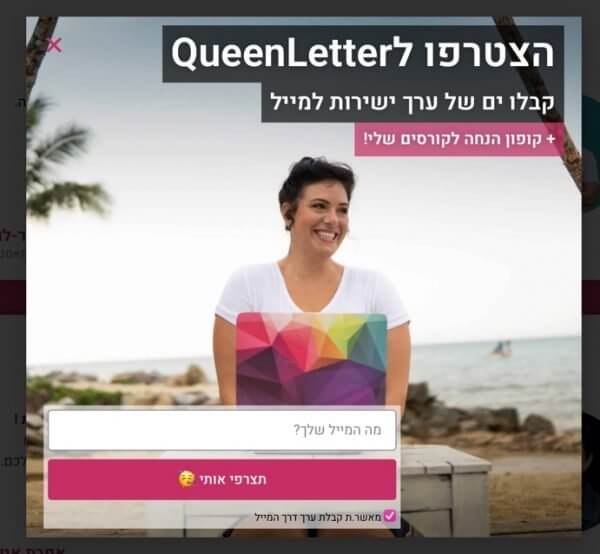
The website is totally under your control: a pop-up on my website
A good website positions you as an authority.
If your audience turns to your blog or content seeking answers, they’ll start seeing you as a viable alternative to other service providers. The more your content addresses their needs and engages them, the closer they’ll come to becoming paying customers.
Dynamic website content builds trust between your audience and your brand.
In professional terms, this is known as Brand Trust.
The stronger the trust, the more likely your audience will remember you when recommending service providers.
Through word-of-mouth, you’ll attract more potential customers, and as trust deepens, your following will grow.
To achieve this, keep creating quality content consistently.
Monetization is much easier through the website.
The mix of visitors to our site is actually made up of returning visitors and occasional visitors.
When we create the profile of our site, we create several “entry points” for different customer journeys.
So, someone who reads the blog will be greeted with a pop-up offering to sign up for the newsletter.
Someone who reads a specific article on a particular topic, let’s say brand creation, will encounter a link that will lead to the purchase of a digital course. And someone who visits the homepage will be able to receive a specific guide only by leaving details…
In fact, there is a call to subscribe to mailing lists, through which later you can send newsletters and various offers or an immediate purchase offer through the website.
Thanks to the website, it’s possible to offer relevant suggestions to visitors on our site, to bring them into a panel where at the end there will be a purchase offer.
Of course, you need to know how to do it and that the content and the offer will be good, but it’s much easier to do it when you have control over the digital asset.
- Analytics
Facebook removed analytics from business accounts at the end of June. Data helps us improve, understand what our audience likes to read, what content works more or less. How can we provide value to our audience properly?
Website traffic data allows us to know where to invest our energy, draw conclusions about the browsing culture on our site, pick out less effective “flows” and of course draw conclusions and tighten the content accordingly.
When there is a website, all you have to do is connect it to Google Analytics and get good and meaningful insights.
Another tool is Hotjar, through which you can see heat maps and understand where visitors linger on the digital asset, what they ignore, and so on…
Summary
Dependency on social networks only deepens.
To be in control of our business activity, it is important to develop and nurture a digital asset that is under our control. A dynamic website with a blog is an excellent example of this.
This does not mean that we forget about social networks and live without them. It just means that we will use them wisely and help distribute our main asset, so that it grows and develops along with our business, exposing it to many more people and relevant audiences – along with the memory and search for content.